Easy Basque Cheesecake (Burnt Top, Creamy Center, No Crust)
A basque cheesecake is a crustless cheesecake baked at high heat until the top turns dark and caramelized while the center stays soft and custardy. It takes just 6 ingredients, and there is no crust to press, no water bath to set up, and no worry about cracks. The dark top is the whole point, not a mistake. This easy basque cheesecake bakes at 400–425°F for 40 to 45 minutes, then cools for 2 hours and chills for at least 4 hours. What comes out is a cake that tastes like crème brûlée met a cheesecake: bitter-sweet on top, rich and creamy inside.
If you have never made a cheesecake before, this is the one to start with. Most cheesecakes punish small mistakes. This one forgives them. A crack on top? Nobody can tell, because the top is meant to look dark and rustic. A wobbly center? That is what you want.
What Is Basque Cheesecake?

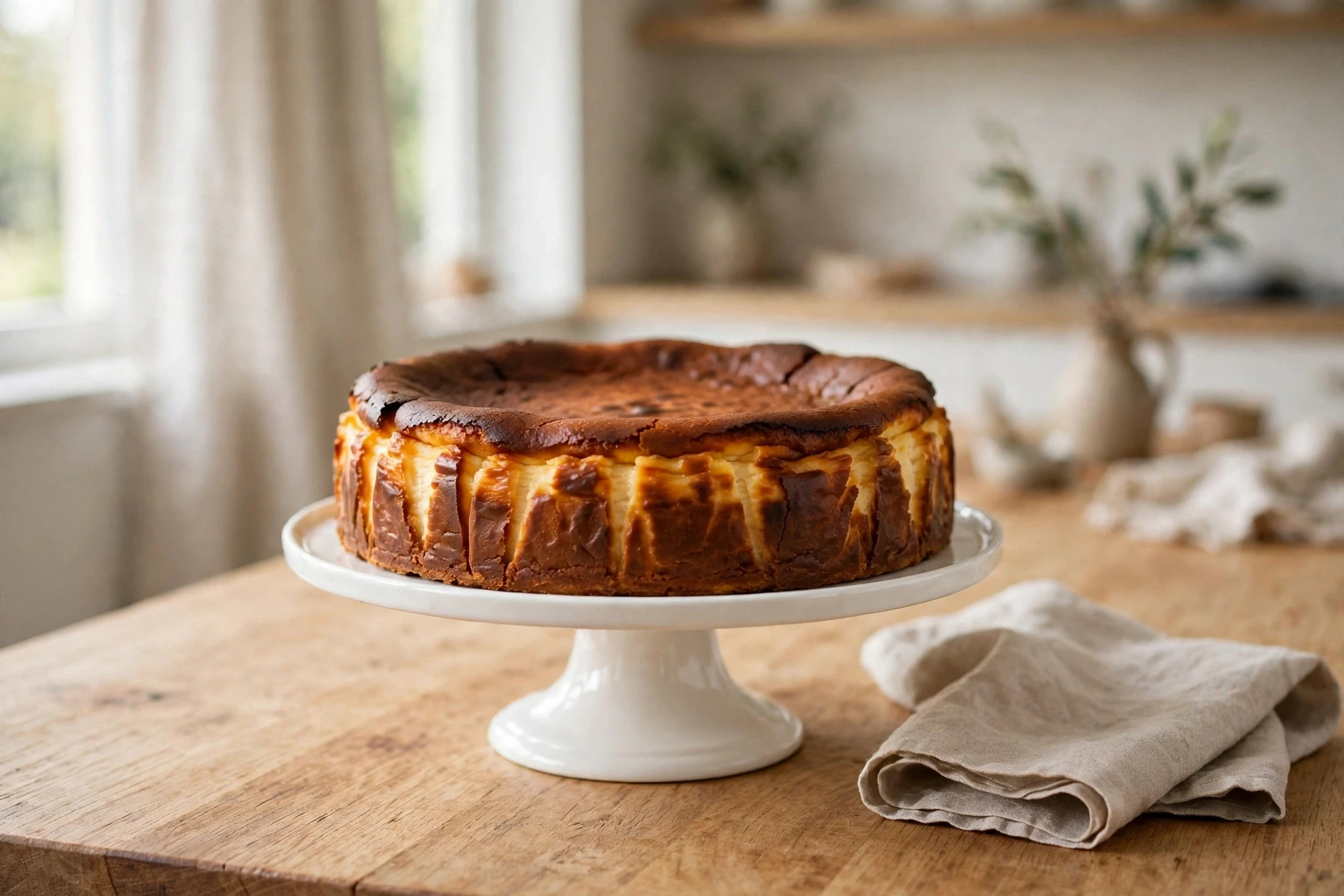
The burnt top is on purpose. A very hot oven caramelizes the sugar on the surface, giving the top a bitter edge, a little like the cracked sugar on crème brûlée, that balances the sweet, rich center. It should go deep mahogany brown, with darker patches that can look almost black in spots. A pale, smooth top means the cake is underbaked for this style, even if the center is set.
Cut into it and you will see the contrast. The edge is set and firm enough to slice. The middle is soft, smooth, and custardy, closer to flan than to a firm New York cheesecake. At room temperature the center turns almost spoonable. Cold from the fridge, it firms up into clean, creamy slices.
| Feature | Basque Cheesecake | New York Cheesecake |
|---|---|---|
| Crust | None — the batter goes straight into a parchment-lined pan | Graham cracker or cookie crust, pressed and baked first |
| Baking temperature | Hot: 400–425°F | Low and slow: 325°F or less |
| Top | Deeply browned, almost burnt, with dark patches | Pale, smooth, and uncolored |
| Center | Soft, custardy, barely set | Firm and dense all the way through |
| Water bath | Never needed | Often used to stop cracks |
| Cracks | Expected and welcome — the top is rustic by design | A flaw to avoid |
| Pan | Any round cake pan lined with parchment | Usually a springform pan |
If you like light, airy cakes with a soft center, try this fluffy cloud cake next. It uses whipped egg whites for lift and is just as simple to make.
Basque Cheesecake at a Glance
The hands-on time is short. Most of the wait is cooling and chilling, and the cake does that work on its own.
| Detail | Amount |
|---|---|
| Prep time | 15 minutes |
| Bake time | 40–45 minutes at 400–425°F |
| Cooling time | 2 hours at room temperature |
| Chilling time | At least 4 hours, or overnight |
| Total time | About 7 hours, mostly hands-off |
| Pan | 9-inch round, lined with parchment |
| Servings | 10–12 slices |
| Difficulty | Easy — good for first-time cheesecake bakers |
Ingredients for This Basque Cheesecake

This basque cheesecake needs only 6 ingredients, and you may already have most of them. Take the cream cheese, eggs, and heavy cream out of the fridge at least 1 hour before you start. Cold cream cheese stays lumpy no matter how long you beat it.
| Ingredient | Amount | Notes |
|---|---|---|
| Block cream cheese | 32 oz (900 g) | Four 8-oz blocks, full-fat, at room temperature |
| Granulated sugar | 1 cup (200 g) | White sugar only — brown sugar changes the flavor |
| Large eggs | 5 (4 also works) | Room temperature; 4 eggs gives a softer center |
| Heavy cream | 1 cup (240 ml) | Also sold as heavy whipping cream |
| All-purpose flour | 2–3 tablespoons (16–24 g) | Just enough to help the cake set |
| Fine salt | 1/2 teaspoon (3 g) | Balances the sweetness |
Use block cream cheese, the kind sold wrapped in foil, not the spreadable kind from a tub. The tub version holds more water, and that extra water can leave the cake loose and a little weepy after chilling.
The small amount of flour helps the cake hold its shape when you slice it, but it is little enough that the center stays custardy. Use 2 tablespoons for a softer center, or the full 3 for clean, firm slices.
How to Make Basque Cheesecake
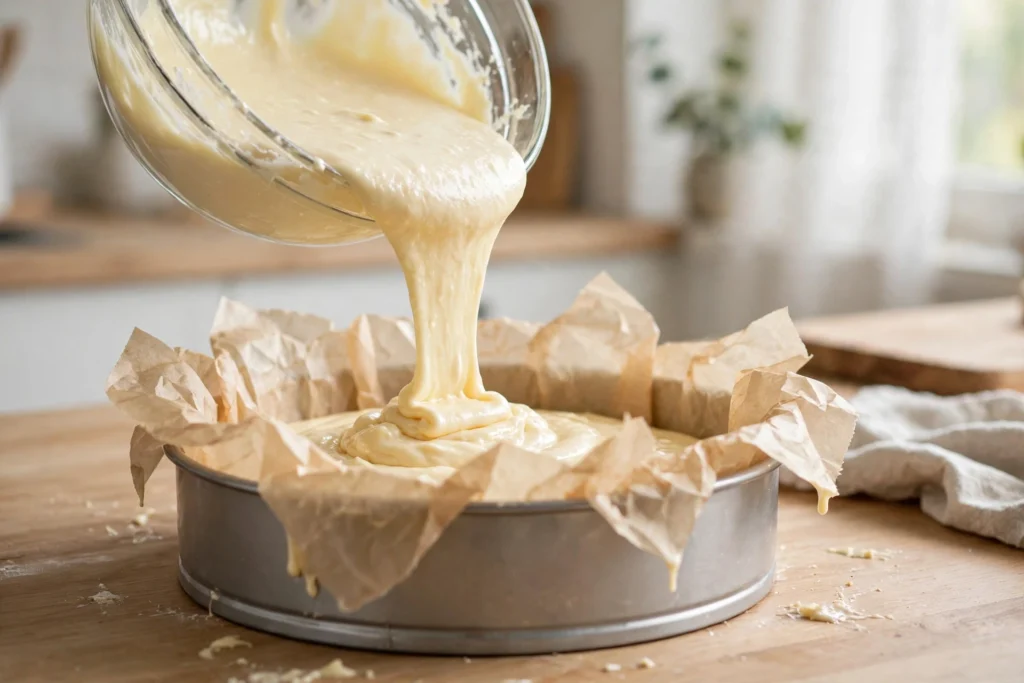
Read the steps once before you start. Heat the oven first, since it needs a full 20 minutes to reach 400–425°F, and line the pan before you mix anything.
Step 1: Line the Pan
Take two large sheets of parchment paper, crumple each one into a ball, then smooth it back out. The creases help the paper sit in the pan. Lay the sheets across a 9-inch round cake pan in a cross shape, so the paper covers the bottom and rises 2 inches above the rim. That tall collar holds the cake as it puffs up, so do not trim it short. A springform pan works too, but a plain cake pan is fine.
Step 2: Beat the Cream Cheese and Sugar
Beat the room-temperature cream cheese in a large bowl on medium speed until completely smooth, about 2 minutes. Scrape the sides once or twice so no lumps hide at the edges. Add the sugar and salt, and beat again until smooth and a little fluffy, about 1 more minute. Stop as soon as it looks smooth. Beating past that point works air into the batter, and too much air can make the cake puff up and then sink.
Step 3: Add the Eggs
Add the eggs one at a time, beating on low speed after each one just until it disappears. Do not rush this step. If you add all the eggs at once, the batter can look split and take longer to come back together. If you still see small lumps, push the batter through a fine sieve into another bowl. That one extra step saves a grainy cake.
Step 4: Add the Cream and Flour
Pour in the heavy cream and beat on low speed until mixed in, about 30 seconds. Sift the flour over the batter and fold it in until you cannot see any dry streaks. Sifting matters, because flour dumped straight in can clump into pockets that bake into white spots. Give the batter a final slow stir, pour it into the lined pan, and tap the pan once on the counter to pop big bubbles.
Step 5: Bake Until the Top Is Dark
Slide the pan onto the middle rack and bake at 400–425°F for 40 to 45 minutes. The cake will puff up high like a soufflé, and the top will turn deep brown with darker patches. Do not open the oven during the first 30 minutes. If the top still looks pale at 42 minutes, switch the oven to broil for 1 to 2 minutes and watch it the whole time, since it can go from golden to black fast.
Step 6: Cool, Then Chill
Let the cake cool in the pan for 2 hours at room temperature. It will sink as it cools, and that is normal. The center will still look soft, and it will firm up as it cools. Once it reaches room temperature, cover the pan and move it to the fridge for at least 4 hours, or overnight. Chilling sets the center and gives you clean slices. Lift the cake out by the parchment overhang, peel the paper away, and slice with a long, thin knife dipped in hot water.
The Jiggle Test: How to Know It’s Done

The jiggle test is how you tell a basque cheesecake is done, and it is the step most people get wrong. When the bake time is up, gently shake the pan. The edges should be puffed and set, and the center should wobble like set jelly. If only a patch the size of a coin ripples, take it out. It will firm up as it cools, and baking it until it looks firm will give you a dry, crumbly cake.
If the whole center still looks liquid, give it 3 to 5 more minutes. A center that is truly liquid will not set in the fridge, and you will end up with a runny slice. Check at 40 minutes, then every 3 minutes after that.
A thermometer gives you a second check. The center should read about 150°F (65°C) when you take the cake out. That is lower than most cakes, and it is correct for this one. The heat left in the cake keeps cooking the center as it cools.
Ovens run hot or cool by 10 to 20 degrees, and this cake bakes hot enough that the gap matters. An oven thermometer is cheap and worth having for this recipe alone. If your first cake came out grainy, your oven was probably hotter than the dial said.
Pan Sizes and Scaling
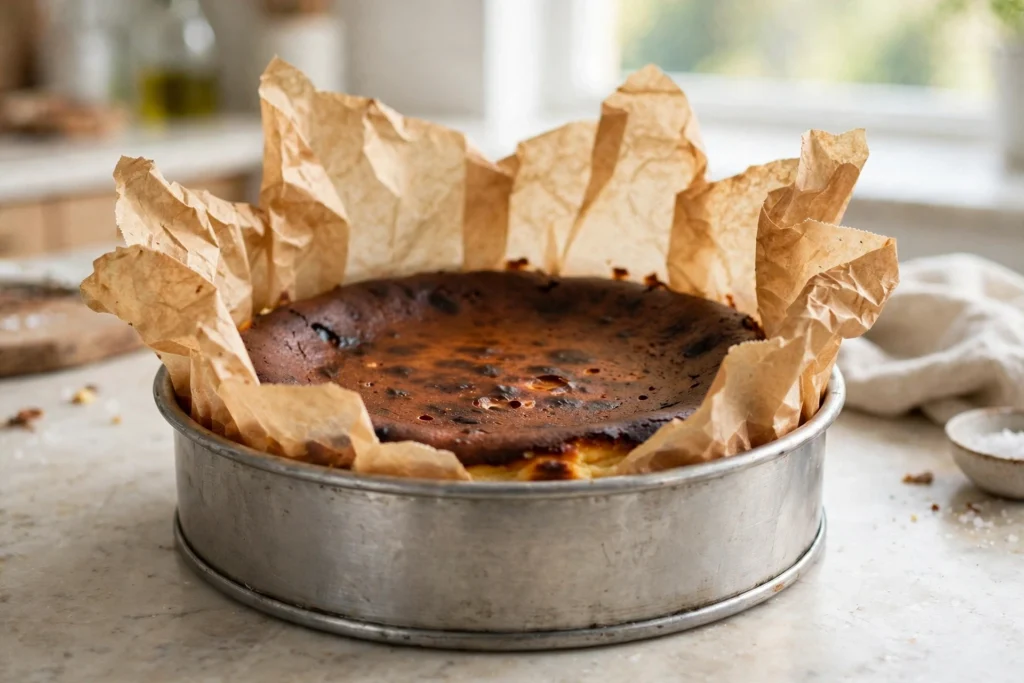
The recipe as written fits a 9-inch pan. You can make it in other sizes, but you need to change the amount of batter, not just the bake time. A pan that is too small will overflow, and a pan that is too big will give you a thin cake that overbakes.
| Pan size | Batter amount | Bake time | Notes |
|---|---|---|---|
| 6-inch | Half batch | 30–35 minutes | Tall, thick slices; great for a small household |
| 8-inch | Three-quarter batch | 35–40 minutes | Close to the original; check at 35 minutes |
| 9-inch | Full batch | 40–45 minutes | The size this recipe is written for |
| 10-inch | One and one-quarter batch | 45–50 minutes | Thinner cake; watch the top so it does not burn |
Whatever size you use, keep the parchment collar 2 inches above the rim. The cake puffs up a lot, and the collar is the only thing holding it in. If your pan is not a springform, the parchment overhang is also your handle for lifting the finished cake out, so leave plenty of paper sticking up.
For mini basque cheesecakes, divide the batter between lined muffin cups and bake for 20 to 25 minutes. They make good single servings, and they chill faster than a whole cake.
6 Basque Cheesecake Variations
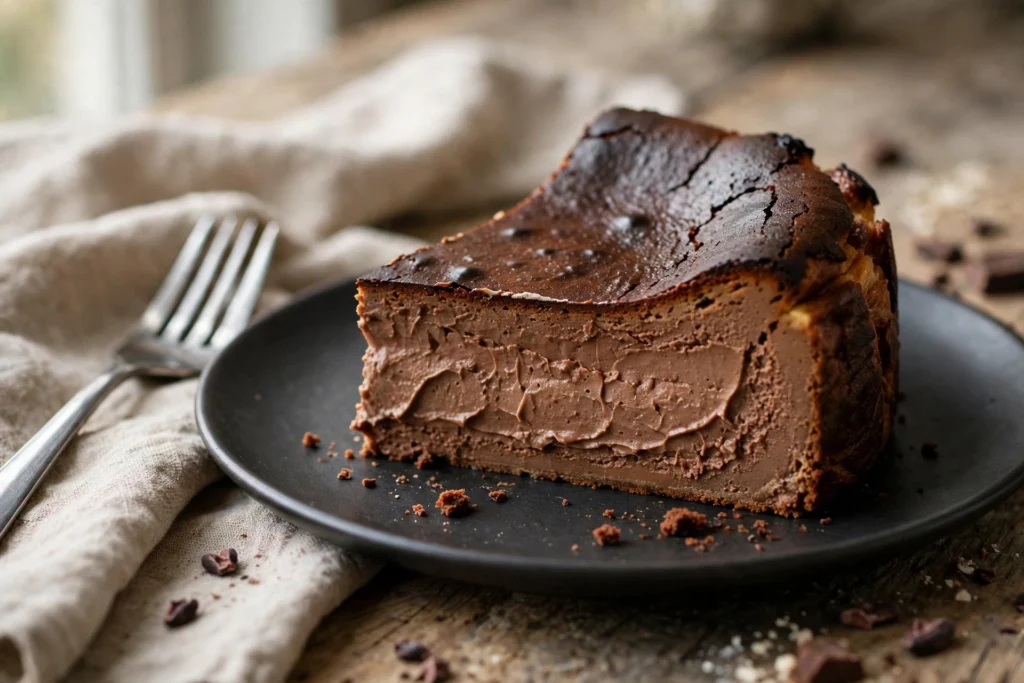
Once you know the classic version, the same batter takes on new flavors with one or two small swaps. Keep the cream cheese, eggs, cream, and flour the same, and change only the flavoring.
1. Classic
The original, with vanilla as the only flavoring. Add 2 teaspoons of vanilla extract with the cream. Make this one first, so you know what the burnt top and custardy center should taste like before you change anything.
2. Chocolate
Swap the flour for cocoa powder and you get a dark, rich cake with the same burnt top. The cocoa deepens the color, so watch the top near the end — it will look darker than the classic at the same stage. A spoonful of chocolate spread swirled through the batter adds a marbled look.
3. Matcha
Whisk 2 tablespoons of matcha powder into the sugar before you add it to the cream cheese. The green stays bright under the browned top, and the matcha adds a light, grassy note that cuts the richness. Use ceremonial or latte-grade matcha, since cooking-grade matcha can taste flat.
4. Pumpkin Spice
Fold in pumpkin purée and pumpkin pie spice for a fall version that still keeps the burnt top. The purée adds moisture, so bake it a few minutes longer and give it the full overnight chill. It tastes like pumpkin pie and cheesecake in one slice.
5. Ube
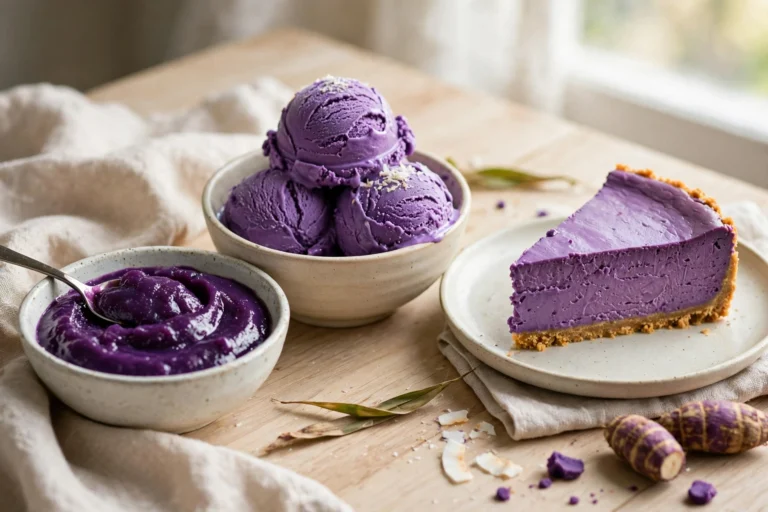
Swirl ube halaya into the batter with a little ube extract for a purple cake with a nutty, vanilla-like flavor. The purple is striking against the dark top, and the ube flavor sits well with the caramelized sugar. Use halaya from a jar if you do not want to make it from scratch.
6. Lemon
Add lemon zest and a spoonful of lemon juice for a bright version. The lemon keeps the cake from tasting too rich, and it pairs well with fresh berries. Do not add more than a spoonful or two of juice, since too much liquid will loosen the batter.
Troubleshooting
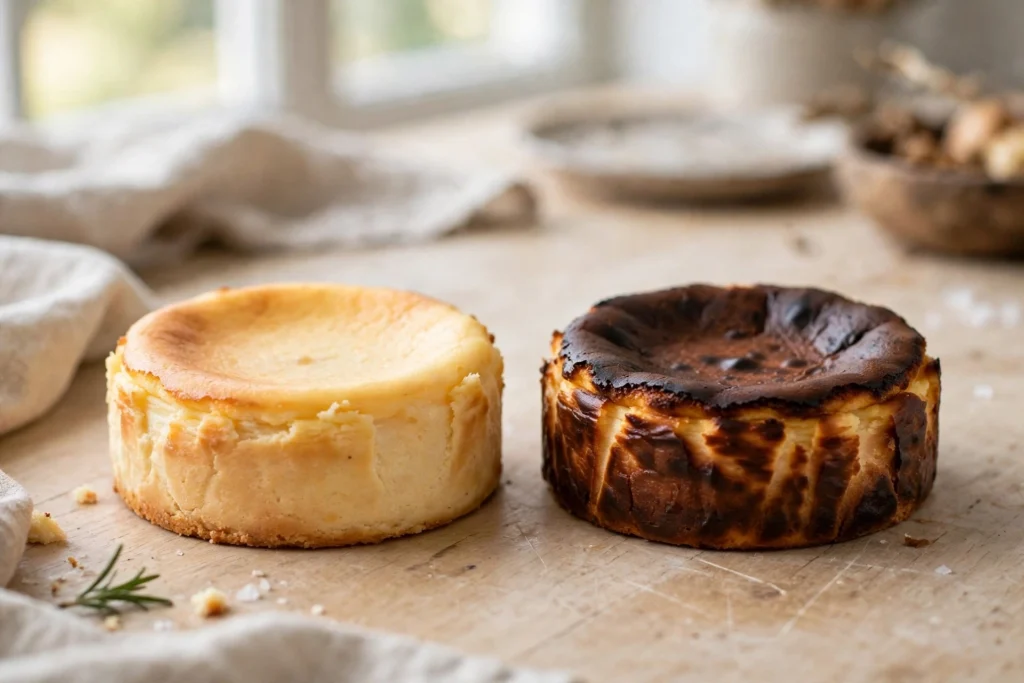
Basque cheesecake is hard to ruin, but a few things can go sideways. Most come from oven temperature or cold ingredients, and all of them have a fix for next time.
| Problem | Why it happens | Fix |
|---|---|---|
| Top is too pale | Oven runs cool, or the cake came out too early | Broil for 1–2 minutes at the end; watch it the whole time |
| Center is too runny after chilling | Underbaked — the center was liquid, not just wobbly | Bake 5–10 minutes longer next time; chill overnight |
| Grainy or curdled texture | Overbaked, or the oven ran too hot | Take it out while the center still jiggles; check with an oven thermometer |
| Lumpy batter | Cream cheese was too cold | Let ingredients reach room temperature; strain the batter through a sieve |
| Liquid on the parchment | A little syrup seeps out during baking | Normal in small amounts; mix gently and it stays low |
| Cake cracked or sank a lot | Too much air beaten in, or a big temperature drop | Beat on low speed and stop when smooth; cool in the pan, not in a draft |
How to Store and Freeze Basque Cheesecake
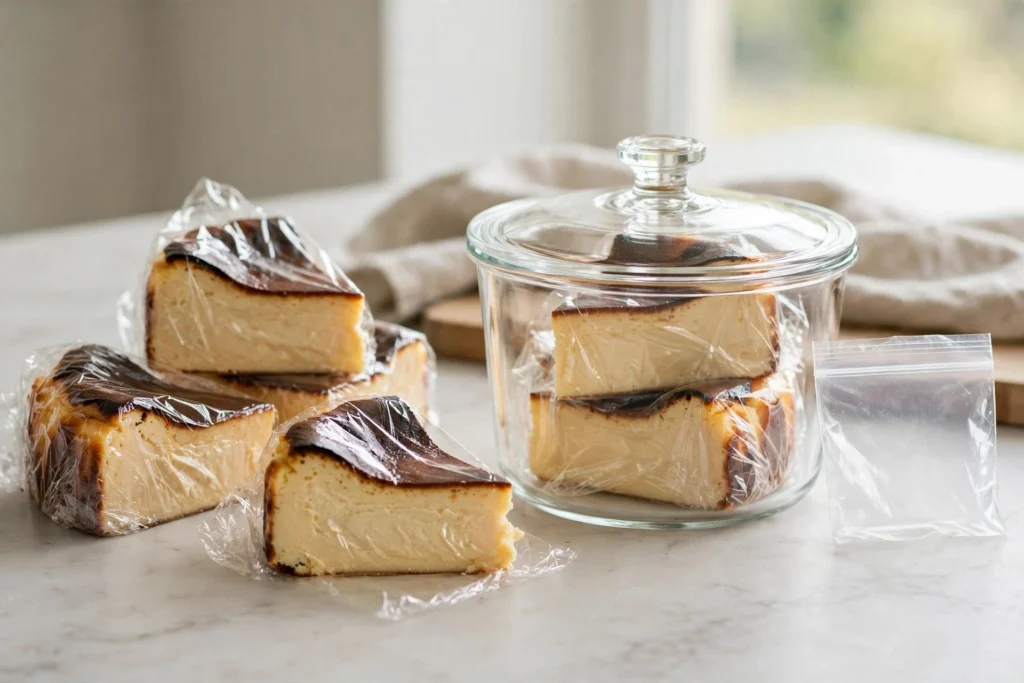
Keep the cake in the fridge, covered, for 4 to 5 days. Press plastic wrap against the cut sides so the cake does not dry out. The flavor is best in the first two days, when the top still has a little bite to it.
To freeze it, slice the chilled cake first, then wrap each slice in plastic wrap and put the slices in a freezer bag. It keeps for up to 1 month. Thaw slices overnight in the fridge, then let them sit at room temperature for 20 to 30 minutes before serving. A cold slice tastes dense and firm, while a room-temperature slice tastes creamy, the way this cake is meant to taste.
Do not freeze the whole cake if you can help it. Slices thaw faster, take up less room, and let you take out one serving at a time.
Basque Cheesecake FAQs
Why is basque cheesecake burnt on top?
The burnt top is the point of the cake. A very hot oven caramelizes the sugar on the surface, giving the top a bitter edge that balances the sweet, creamy center. It should look deep mahogany brown, with darker patches that can look almost black. A pale top means the cake missed the step that gives it its flavor.
How jiggly should the center be?
When you shake the pan, the edges should stay still and the center should wobble like set jelly. If only a coin-sized patch ripples, the cake is done. If the whole center sloshes like liquid, it needs 3 to 5 more minutes. The center firms up as the cake cools and chills, so do not wait for it to look firm in the oven.
Do I need a water bath?
No. A water bath is for cheesecakes that must stay pale and smooth, and this cake is the opposite. It bakes hot on purpose, and the dark, cracked top is part of the look.
Why is my basque cheesecake grainy?
A grainy or curdled texture almost always means the cake was overbaked or the oven ran too hot. Take the cake out while the center still wobbles, and check your oven with a thermometer. Cold cream cheese can also cause lumps, so let everything reach room temperature before you mix, and strain the batter if you still see lumps.
Can I freeze basque cheesecake?
Yes. Slice the chilled cake, wrap each slice in plastic wrap, and freeze the slices in a bag for up to 1 month. Thaw them overnight in the fridge, then let them sit at room temperature for 20 to 30 minutes so the center turns creamy again.
Conclusion
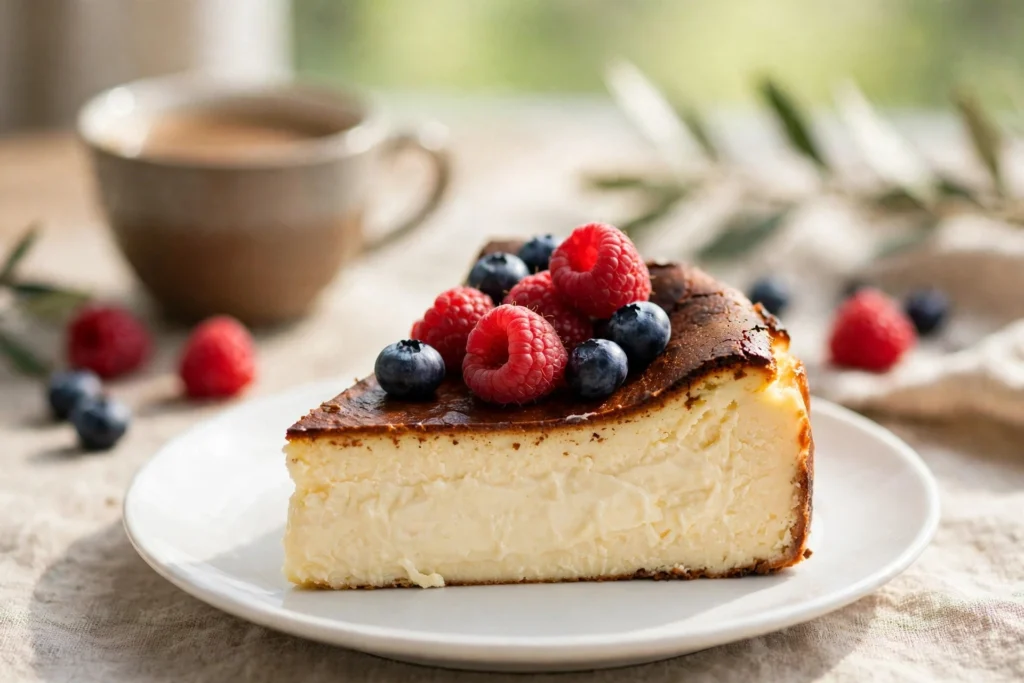
This basque cheesecake proves that the easiest cheesecake can also be the best one. Six ingredients, one bowl, no crust, no water bath, and a hot oven does the rest. The dark top gives you caramel flavor, the center stays soft and custardy, and it all comes together in about 15 minutes of hands-on time.
Make the classic version once, trust the jiggle test, and give it the full chill before you slice. Once you see how simple it is, the variations are waiting — chocolate, matcha, pumpkin spice, ube, or lemon, all from the same batter.